English Words About the Moon and Stars for Kids
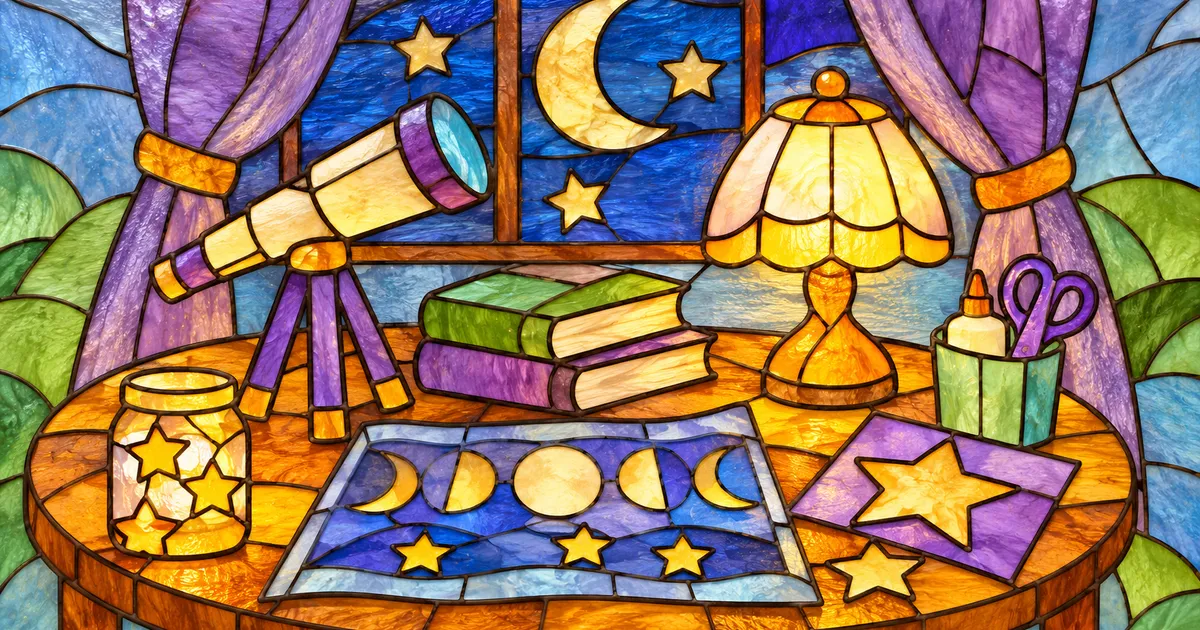
English Words About the Moon and Stars: Activities for Kids starts with 24 useful words that children can see, say, and use in short sentences. Begin with familiar sights such as the moon, stars, and night sky. Then add space words such as planet, orbit, and astronaut. Younger children can point, draw, and act. Older children can describe changes, compare objects, and ask simple science questions. The aim is not to teach a full astronomy lesson. It is to give your child clear English for talking about a subject that naturally invites wonder.
Core Words for the Night Sky and Space
Teach six to eight words at first, then add more when your child can recall them without help. Say each word, show a picture or object, and use the example sentence. Nouns come first because children can point to them. Describing words and verbs can follow.
English Words About the Moon and Stars: Activities for Kids works best as a speaking set, not a list to memorise in one sitting. Ask your child to choose four words, draw them, and say one sentence about each picture.
Putting the Words into Useful Sentences
Build from short patterns that children can reuse: “I can see a star,” “The moon is bright,” and “The rocket is in space.” Change one word at a time. Your child can replace star with moon, or replace bright with full.
Questions add another useful step. Try “What can you see?”, “Is the sky dark?”, “How many stars can you count?”, and “Which moon phase is this?” Accept a one-word answer first, then model a full reply: “Full moon” becomes “It is a full moon.”
To make English Words About the Moon and Stars: Activities for Kids part of real communication, connect the sentences to what your child can observe. A cloudy evening still gives useful language: “I cannot see the moon,” “The clouds cover the stars,” or “We will look again tomorrow.”
Activities for Different Ages
School-age Kids: Point, Move, and Match
Place picture cards for moon, star, rocket, and astronaut on the floor. Say a word and let your child jump to the right card. Next, reverse the roles: your child says the word and you move. Finish by making a paper night sky and naming each item as it is added.
School-age Kids: Observe and Record
For English Words About the Moon and Stars: Activities for Kids, a simple moon log gives the vocabulary a clear purpose. On three or four evenings, your child can draw the moon and complete two lines: “The moon looks…” and “I can also see…” Treat the drawing as an observation, not a test of artistic skill.
School-age Kids: Explain and Compare
Older learners can prepare a one-minute space report using five target words. They might compare the moon with Earth, explain the meaning of orbit, or describe a constellation. Ask one follow-up question so that the task becomes a conversation rather than a speech learned by heart.
Short Practice Ideas for the Week
Keep practice brief and varied. On one day, sort words into “things,” “people,” and “actions.” On another, play “Odd one out” with sets such as moon, star, rocket, banana. Your child must name the odd word and, when ready, explain the choice in English.
Five-minute Sky Challenge
Choose six words from the table. Ask your child to draw a night scene that includes at least four of them. Then take turns making true or false statements about the picture: “The astronaut is on Earth.” Your child answers, corrects the sentence, and points to the matching detail.
Review should bring back known words as well as new ones. Use two easy words, two words that still need help, and one new word. This balance gives your child a sound base while keeping the task fresh. Across LearnLink lessons, our tutors also place new vocabulary inside questions, games, and short exchanges.
Common Word Mix-ups
Space vocabulary includes words that children may treat as interchangeable. Correct the meaning through a clear contrast, then return to the activity. A short model is usually more useful than a long interruption.
Children may also omit the before moon, sun, and sky. Model “The moon is bright,” not “Moon is bright.” We normally say space without the in phrases such as “in space.” Repeat the correct sentence naturally and invite your child to try it once.
- Choose four picture cards and ask your child to label each space word.
- Contrast moon and star aloud, then sort six matching pictures together.
- Read one space book and pause whenever two similar words appear.
- Write three confusing word pairs, then draw a simple clue beside each.
- Review the pairs at bedtime and let your child explain each difference.
When a word has several meanings or pronunciations, Cambridge Dictionary is a useful check before turning it into child-friendly examples.
Frequently Asked Questions
How Many Space Words Should My Child Learn at Once?
Start with six to eight words for a younger learner and adjust according to recall. A child who can point to a picture but cannot yet say the word still needs more practice with that set. Older learners may handle more words, but they should also use them in sentences, questions, and short explanations.
Should I Correct Every Pronunciation Mistake?
Correct a mistake when it makes the word hard to understand or when your child is ready to repeat it. Give one calm model, break a longer word into parts if needed, and continue. For example, say “as-tro-naut” slowly and then at normal speed. Avoid turning every activity into a pronunciation test.
Does My Child Need to Understand Astronomy First?
No. English vocabulary can grow alongside basic knowledge. Begin with things your child can see in a picture or the night sky, then explain terms such as orbit and phase in plain English. If a question needs deeper science, look up the answer together rather than asking your child to guess.
How Often Should We Practise These Words?
Several short sessions are easier to sustain than one long vocabulary lesson. Treat English Words About the Moon and Stars: Activities for Kids as a menu. For each session, follow three steps: choose six words, practise one sentence pattern, and finish with one five-minute activity. Revisit difficult words later in the week and use them again during the next moon or sky observation.
A short one-to-one lesson can show what level and pace fit your child — book a trial English lesson.
Stay updated on our latest tips and resources by following us on Instagram LearnLink.